This past summer, a friend of mine hosted a gathering at her family’s home in Vermont. It was a reunion of sorts, equal parts restorative and raucous, and offered welcome doses of pond-swimming and sprawling conversation.
In college, I habitually woke up early—even on weekends. On those quiet mornings I would journal, or read, or recover from the night before with a heaping bowl of oatmeal loaded with walnuts, cream, and maple syrup. This past summer, more than a decade after graduation, I still rose around dawn to a sleeping house and splattered some words in my moleskine. It then occurred to me that a quiet walk with binoculars would be far more interesting than journaling in bed.
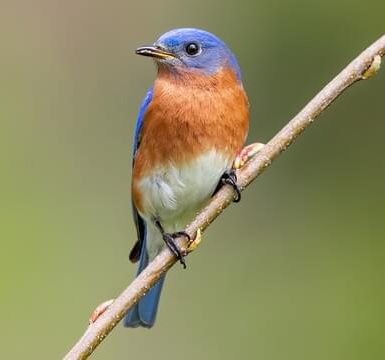
My walk down the dirt road was graced by curious common yellowthroats, striking northern flickers, and even a shy ruffed grouse. Each of these encounters stopped me in my tracks, and I marveled at the birds until their lives and needs brought them elsewhere. But none of them moved me so deeply as one solitary bluebird, perched atop a maple tree, singing out with a sunny golden warble.
I watched the soft feathers on his breast rise and fall as he called, the rust-peach plumage filling with air before each articulated burst. He sang like his life depended on it—it’s likely that his bloodline did. The morning sky matched the vibrant feathers on his head and back.
If you have watched birds, you know the magic of hearing a song permeate a forest, or yard, or park, then finally setting eyes on the individual producing the sound. There is something deeply marvelous about realizing that this great big voice, lending such character and life to the expansive outdoor space, is coming from one tiny being.
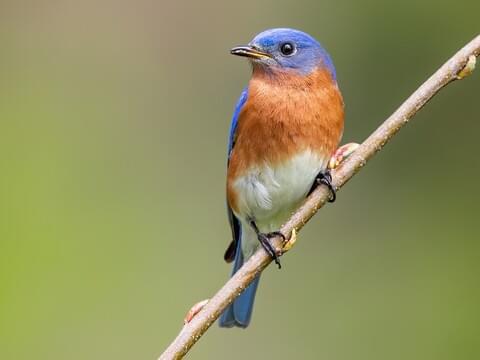
photo from The Cornell Lab. Click here to learn more about the eastern bluebird.
I watched the bluebird until my hunger and the climbing sun called me back to the house. The experience had flooded my consciousness with a principle that I have long held dear: none of this world is for us.
Surprising moments like this are especially humbling because so much of what humans experience and consume is made for us—advertisements, fiction, news, social media, street signs, menus, video games, movies, books, podcasts—so much of what we ingest is designed to make us feel or act a certain way. So much is made for us… that if we aren’t careful, we might believe that the world is made for us! And if we believe the world is made for us, we might use it however we like, exclusively for our own species’ advantage. (Spoiler: this is what’s happening on Earth.)
In this way, paying attention to the natural world does not only bring us awe and delight–it also serves as an antidote to human entitlement and arrogance. It can even be an act of rebellion against powerful manmade entities strategically vying for our attention. Perhaps most importantly, paying attention to the natural world actively inspires us to acknowledge and care about other species. As one of my graduate professors put it, “deep attention equals love.” Humans are less likely to believe that the world is for us, less likely to think we’re at the center of the universe, and less likely to continue our practices of mass destruction, if we are in tuned into the more-than-human world.
 FOR THE LOVE OF EARTH