I feel so grateful for two guilt-free days off—a welcome gift from my nonprofit employer. Lately work has felt like more of a grind than usual, and the holidays are their own kind of hustle. This morning I woke up to blue skies and made myself a robust two-egg scramble with broccoli, cherry tomatoes, chicken bacon, and cheddar. Throughout this pregnancy, my hunger has been conspicuous and controlling. Actual dreams about cooking and eating launch me out of bed to immediately make a proper breakfast. Is this what it’s like to be a mom? —feeling powerless under primal needs that must be met before I can think about anything else? Whether hunger, exhaustion, or sexual desire, every sensation for the past three months has been huge and urgent. Will my impulse to protect our child be this powerful? It all feels very animal.
After breakfast and tidying the kitchen, I bundled up and headed to the dock with my binoculars. We’ve had a spell of warm days recently, but this morning I had noticed frost on the grass outside.
On the way towards the water, I heard a woodpecker a-knocking—likely a downy or a hairy—and gazed up towards the sound. In a tangle of sleeping deciduous and shabby spruce, I noticed two brown creepers hopping deftly along the bark. They are incredibly well camouflaged—I only see them when I’m looking for somebody else. How many adorable brown creepers have I passed without realizing? My friend Bridget taught me that creepers (along with other tree-clingers) have feet shaped like X’s, ideal for scaling bark and even hanging upside-down. Feet of this shape are called “zygodactyl.” I think this word has too many letters for Scrabble, but maybe it will help you to win Bananagrams someday. This adaptation enables some birds to defy gravity with extraordinary precision—as if flight is not impressive enough!
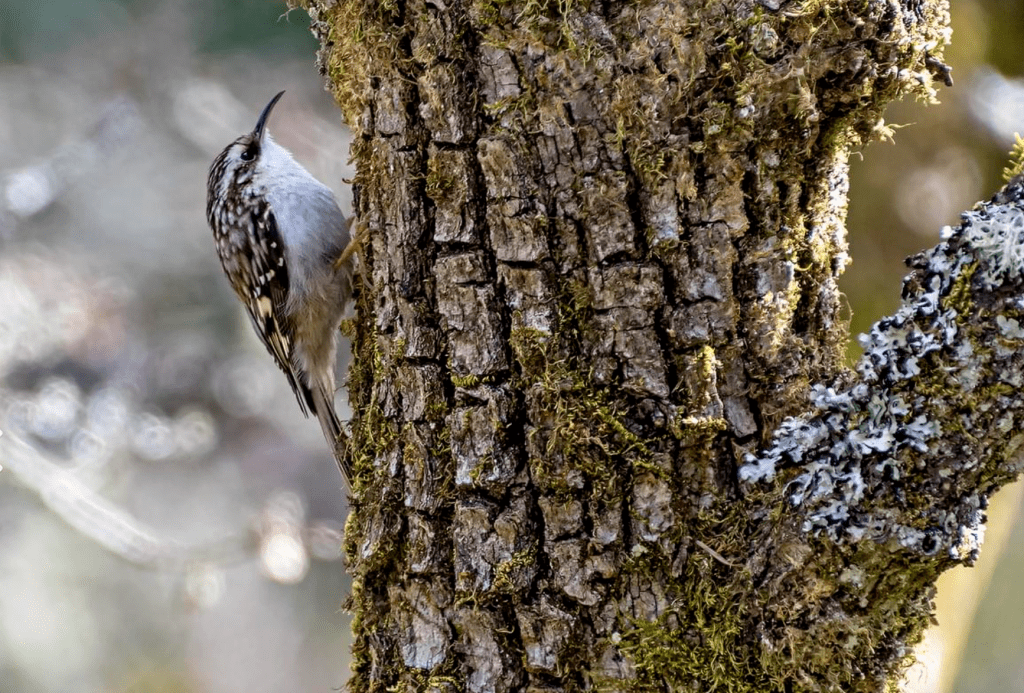
photo from The Cornell Lab. Click here to learn more about the brown creeper.
Eventually I spotted the woodpecker: a male hairy with a perfect maraschino cherry marking on the back of his head. Tap-tap-tapping away. What was he eating? Something healthy and delicious, I hope. I wished him buen provecho and continued crunching through the woods.

photo from The Cornell Lab. Note the zygodactyl feet! Click here to learn more about the hairy woodpecker.
Not far from my perch aboard the sailboat, a sturdy loon floated silently. Others howled outrageously in the distance. I found myself wondering whether loons were named after crazy humans… or lunatics after the waterfowl. Most likely the former, considering luna probably has a latin root related to the moon—I learned once that people used to believe you’d go crazy if you spend too much time under the moonlight. Hence the word lunatic—hence, definitely the former. Hindsight is 20/20, by the way. Which current “truths” will age as poorly as this dangerous-moon-theory did?
Not far from the loon was a much smaller floating bird—an alcid of some sort. She was white with black markings and a stout build that would serve her well on the high seas. I watched intently and counted the time she spent under water—upwards of forty seconds!—and the time she spent afloat—less than eight! I was amazed by her breath-hold, and found myself reflecting on how lousy humans are at so many things.
How would I be able to identify this lovely ocean-going bird? The beak wasn’t the right shape to be a dovekie, and she obviously was not a puffin. This fluffer appeared to be a juvenile, snow-white with sooty black patches behind her eyes and along her back. A delicate beak and —aha! vibrant webbed feet the color of a traffic cone. When I returned home to my field guides and birding app, this would be the feature that enabled me to identify her as a black guillemot (rather than any sort of murre). We saw so many guillemots when living and sailing in California; it warmed my heart to see one here in Maine.
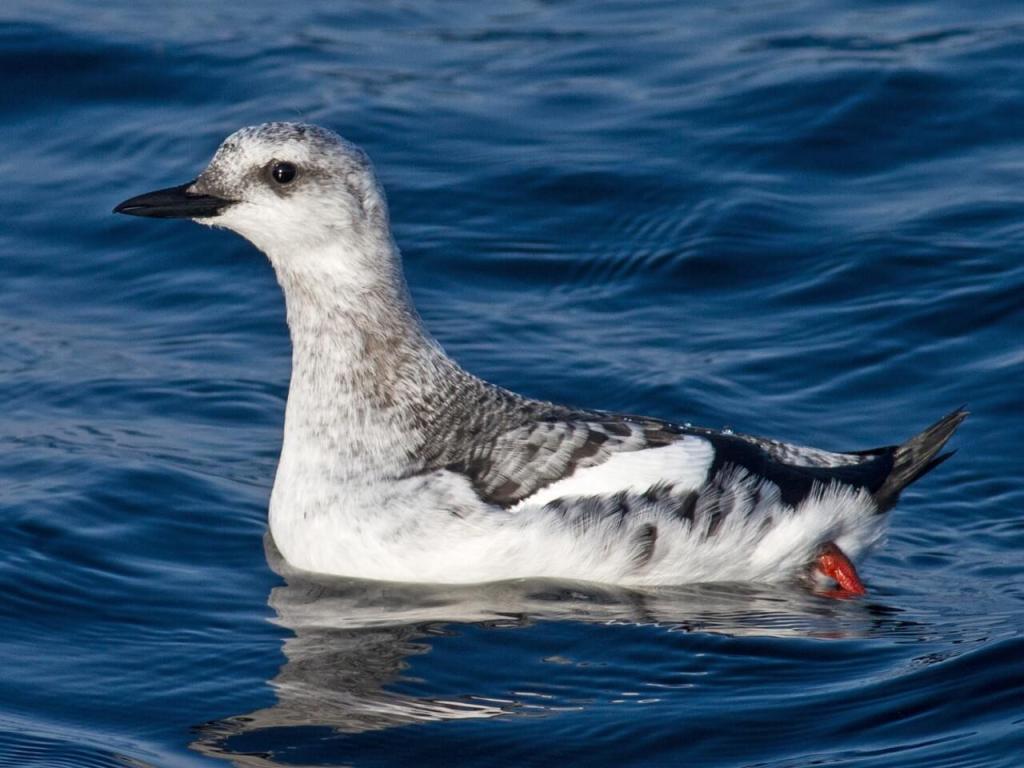
photo from The Cornell Lab. Click here to learn more about the black guillemot.
I was lucky enough to encounter a dozen or so other bird species this morning, between my walk home through the forest and a cup of tea by the feeder. This chapter of my life is demanding that I slow down like never before, and I’m still adjusting to the change. Fortunately, we share this quiet island with a community of extraordinarily talented, beautiful, and interesting neighbors.
 FOR THE LOVE OF EARTH